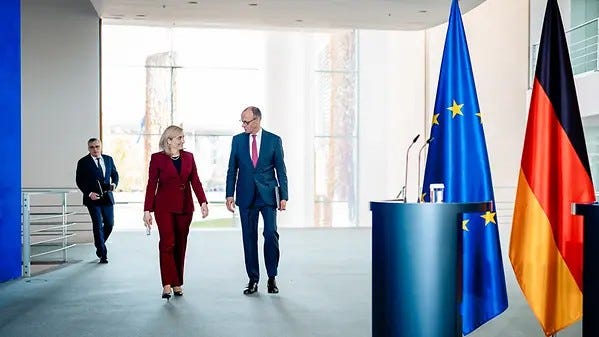
Can Merz fix Germany?
The government wants to pass major reforms and cuts by the summer. This week: healthcare
“2026 is a fateful German year. If Germany is unable to get out of this recession, there’s a feeling that democracy is at risk…. at least parliamentary democracy as we know it, where decisions are made by the political centre.”
That's journalist Robin Alexander on his political podcast Machtwechsel. Overly dramatic? Maybe not. He's essentially saying that if the government fails to fix the economy very soon, the CDU could switch to a coalition with the far-right AfD — uncharted territory.
Robin Alexander isn't alone in his assessment.
“This is the most challenging economic situation in Germany since the war,” says economist Jörg Rocholl.
It’s popular to hate politicians but right now you have to have some empathy for Chancellor Friedrich Merz (CDU) and his Finance Minister and Deupty Chancellor Lars Klingbeil (SPD). This awkward couple stand before a Herculian task: Produce sweeping, effective economic reforms within a few weeks. Reforms that have been neglected for years.
But first, more on the current state of Germany. It’s pretty dire:
The economy has been stagnant since 2019.
Despite a tiny seasonal uplift in April, 77,000 more people are jobless compared to a year ago.
We're seeing the highest level of company bankruptcies in 20 years.
Inflation rose to 2.9% in April. (Thanks to the Iran war)
And the latest polls: The AfD is no longer neck-and-neck with Merz's CDU/CSU, it's charged several points ahead.
from our partner
RiutBag: surprisingly secure laptop backpacks for calm city travel on every journey ✈️🚆🚇💻
Get 10% off with code UPDATE10
Quick fixes, large and small
As a short-term reaction to the energy shock of Trump’s war, the government banged out the Tankrabatt, a temporary 17-cent cut on fuel taxes, and the Krisenbonus, a voluntary tax-free payment of up to €1,000 that employers can offer their workers.
Critics say these one-off measures are just Flickwerk (patchwork).
More or less everyone agrees that to get Germany back on track, significant structural reforms are required. Now. The last significant structural reforms were the Agenda 2010, spearheaded by SPD Chancellor Gerhardt Schröder nearly 25 years ago. Those reforms increased social inequality but kept Germany export-focused industry humming during the Merkel years.
Now, Merz and co. are attempting to punch through sweeping reforms in:
Healthcare
Pensions
Taxes
Digitalisation
The thinking goes: These fields directly affect the competitiveness of companies and the lives of normal people. Health insurance and pension contributions are a direct cost to employers and employees alike. Lowering those contributions, along with income tax, is supposed to put more money in everyone’s pocket — boosting the economy.
In short, more money, less hassle for everyone. That's the idea, at least.
Finding 15 billion
This week, Health Minister Nina Warken (CDU) got her reform package approved by the Merz cabinet, so I’ll focus on that.
The sickness:
The 93 gesetzliche Krankenkassen (statutory health funds) that insure 75 million people are showing a 15 billion euro deficit this year alone.
Germany spends 12.6% of GDP on healthcare. Only the US pays more.
Nina Warken’s medicine:
Homeopathic medications and medical cannabis no longer covered by the Krankenkassen.
Pharmaceutical companies must offer higher discounts to pharmacies.
Limits to Krankenkasse spending on manager salaries, admin and ads.
Co-payments on meds up by 50%. Meaning patients pay at least €7.50 instead of €5 for prescription medications.
Krankenkasse subsidies for crowns/dentures lowered by 10%.
Health insurance no longer free for non-working spouses unless they are taking care of kids under 7, disabled children or elderly people. Otherwise families will be charged 2.5% of the working partner's income to insure the non-working one. This is intended to bring in more money and nudge more people (mostly women) into employment.
Second opinion required to help prevent unnecessary surgeries.
My take
The German system is generous to patients but we pay vast sums of money for it. And it’s insanely inefficient.
Most of these reforms seem reasonable to me and will hopefully keep contributions stable for now.
Requiring a “second opinion” on surgery makes a lot of sense. A second opinion saved me from a major knee operation recommended by an orthopaedic surgeon with a lot of expensive artwork on his office walls.
Stuff that’s not being touched:
German doctors are forced to spend endless hours on paperwork. This reform package does nothing to change that.
Germany healthcare has many wasteful, redundant structures. For example, the 93 Krankenkassen offer near-identical services but each have their own executives, apps, marketing budgets, and bureaucracies. Reduce them to five or ten and you'd get economies of scale while maintaining some competition.
More digitalisation could save billions.
Scrapping private insurance is probably also not a bad idea. Germany’s the only EU country where millions are 100% privately insured. It’s unfair and overly complicated. 72% of Germans say scrap private health insurance altogether.
Warken’s updates might plug the budget hole for a few years but the vast demographic and technological shifts on the horizon mean the system should be in a state of permanent reform, constantly seeking efficiency wherever it can, or else healthcare costs will become a massive burden on citizens and the country as a whole.
The health reform package is just draft legislation. It must still make it through the Bundestag, where parliamentarians will try to water down different aspects. Most of all, it will have to survive the onslaught of armies of lobbyists representing special interests from doctors to big pharma.
If we’re to believe veteran political observers like Robin Alexander, the window for reforms could close by the summer. Three eastern states — Berlin, Sachsen-Anhalt, Mecklenburg-Vorpommern — hold elections in September. Apart from Berlin, the AfD stand to do exceptionally well. The reforms must be done and dusted before campaigning begins mid-summer.
And if Merz doesn’t manage to turn around the German tanker, it could get a lot, lot worse. Some voices in the CDU are already calling for a coalition with the AfD, who would be more open for pro-business reforms than the SPD. Those voices will grow much louder. Merz could sucuumb to pressure and ditch the SPD as his coalition partner, who are doing far worse than his own party in the polls, and enter into an alliance with the extreme-right, racist populists.
The stakes couldn't be higher.
Thanks for reading,
Maurice
What else happened this week?
🪖 US withdrawing 5,000 troops from Germany
🤑 Merz: State pensions will only provide basic coverage
♻️ Germany is the world’s largest exporter of waste plastic
💪 Europe’s hesitant superpower in waiting
🎮 TGNG is a “peaceful world-domination game” made in Berlin
📺 German stay-at-home dads on the rise
💰Money-Saving Tip of the Week from Smart Living in Germany
If your savings are sitting in a bank account earning little to no interest, it’s worth moving them somewhere better. The two main options are a Tagesgeldkonto (a flexible account where you can move money in and out whenever you want) and a Festgeldkonto, which locks your money in for a fixed period (typically 1–3 years) in exchange for a guaranteed rate. Right now, the best rates sit around 3–3.40% for new customers, though most of these are special offers that only last 3–6 months.
Some current accounts also pay interest of up to 2% on your balance, so a separate savings account isn’t always necessary. For all current rates and the best options on the market right now, check out this guide to best savings accounts in Germany from Smart Living.
My other newsletters:
Friends:


Thank you for this really helpful rundown. I haven't been sure how to think about the health insurance reforms. But as you write, these do seem reasonable. I used to be on Private and was able to transfer to Gesetzlich when I went freelance (also joined the KSK). I've been very happy on Gesestzlich (TKK) but I'm glad I had private when I did (this is why: https://eleanorreagh.substack.com/p/a-tale-of-two-health-care-systems?r=bfqd&utm_campaign=post-expanded-share&utm_medium=web) It seems like a lot of people would NOT like abolishing the private health are system, no?