#35: A flag with complications
With Germany into the second round of the World Cup, the flags are popping up on cars and balconies.
The Deutschlandfahne has been through a lot.
The colours of the modern flag go back to resistance against French occupation in the early 19th century. During the Napoleonic Wars of 1813-1815 (that's “wars of liberation” for the Germans), students formed a volunteer militia called the Lützow Free Corps. For lack of proper uniforms, they dyed their clothes black, added brass buttons and red trimmings, hence Schwarz-Rot-Gold.
The colours in fact hark back to the much earlier imperial flag of the Holy Roman Empire, which was neither holy nor Roman nor an empire, but a loose confederation of hundreds of German-speaking statelets.
quick ad break
Finding a flat in Berlin is a full time job - everyone knows that.
“With Get The Flat, I had a minimum of 10 applications a day. After barely two months, I got my dream apartment!”
In 1832, the flag in its current form was flown for the first time at the Hambach Festival, a get-together of supporters of German democracy, freedom and unity.
Liberal thinkers imposed a new layer of meaning to the colours.
“Black symbolises the night that lay over Germany during foreign rule; gold, the dawn of the freedom that was won; and red, the lifeblood with which it was fought for.”
- Karl Hermann Scheidler
It became the banner of the failed 1848 revolution, and was officially adopted by the Frankfurt Parliament, Germany’s first democratically elected assembly.
But it didn’t become Germany’s national flag until the Weimar Republic after World War II.
The Nazis weren’t keen on the associations with liberty and democracy, so they banned it and reinstated the black-red-white colours of the Second Reich, albeit in the form of the swastika.
In 1945, the Federal Republic said no to that version of Germany’s past and reached back to the flashes of democratic sentiment in pre-Nazi times.
For decades, people were pretty low-key about displaying it. Hardcore neo-Nazis might fly the black-red-white 19th century imperial flag over their Schrebergarten.
The East Germans had their own red-black-gold version with some communist Schnickschnack laid over it.
German unification saw a flurry of flag-waving, as did subsequent FIFA World Cups. Since Germany hosted the football tournament, it’s been acceptible to wear a lei made of patriotic petals.
People who fly the flag year round are probably sharing a more nationalist message in line with the Alternative für Deutschland — who have essentially claimed the old republican flag for themselves. Which is a bit rich considering the hodge podge of ideologies represented by members and supporters of the party, from Reichsbürger types to Neo-Nazis to GDR nostalgics. Most observers agree that if they took control of the national government, the AfD would deliberately weaken the democratic institutions of the Federal Republic, so they shouldn’t be allowed to claim the flag for themselves.
These people are trying hold on to some idiotic, pure notion of national culture and ethnicity. That's not what this flag is about. It’s about democratic values.
And if there’s anyone who is going to lead us into the darkness which the black stripe represents… well you know who.
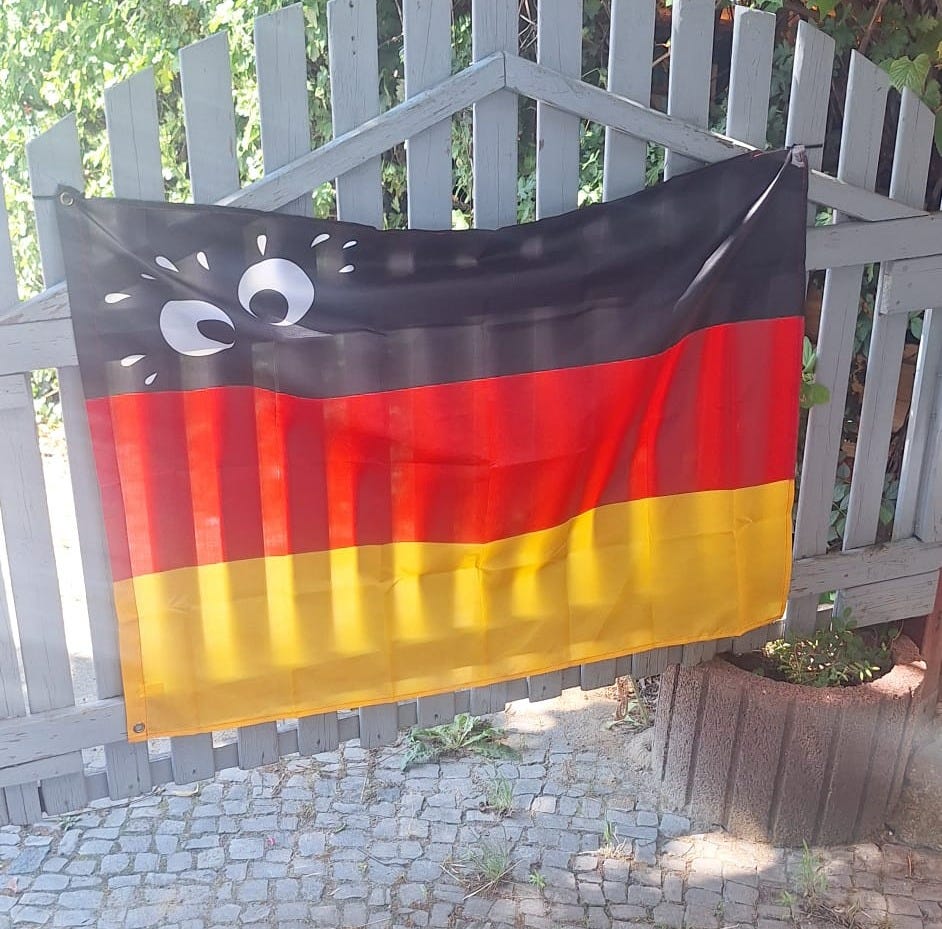
Which is why I love seeing hybrids like this:
A German born and raised abroad, I’ve been pretty unenthusiastic about the German flag all my life. I don’t find the combination of colours particularly aesthetic. I flinch when I see football fans waving giant tricolours a little too enthusiastically.
I lived in Denmark for a couple of years so I’ve seen a country be relatively non-toxic about its flag. The Danes use theirs to decorate birthday cakes or demarcate the path to a party. Which is fine if you’re Danish but annoying if you’re not.
Maybe we just need to achieve a cultural shift to the point that the German flag = birthdays and store openings. Nothing more and nothing less.
Thanks for reading!
Maurice
What else happened this week?
🔥 Heatwave hits Germany with temperatures of 40°C
💰 Merz vows to fully implement pension reform proposals
⚖️ Germany may scrap law banning insults against politicians
⛏️ Germany reconsidering coal power
💊 US launches trade probe into Germany’s pharma pricing
🚆 Germany’s rail network paralyzed by nationwide IT outage
💰 Money-Saving Tip of the Week from Smart Living in Germany
Planning train trips around Germany this summer? It's worth getting a Probe BahnCard 25 before you book – even for a single journey. The three-month trial costs €19.90 and takes 25% off all long-distance fares, including Sparpreis and Super Sparpreis, so it pays for itself once your ticket costs around €80.
Just set a reminder to cancel before the three months are up, or it renews into a full-year card. If you travel more often, a yearly BahnCard 25 or 50 is the better deal. For more ways to cut the cost of train travel in Germany and across Europe, see this train travel guide and subscribe to the Smart Living in Germany newsletter.
My other newsletters:
Friends:


Canadians fly the flag a lot. All it says is “I’m happy to be from here and how lucky we are to have all this.” (Fly whatever flag you want if it makes you happy)
I don’t know Germans to be a happy people, and I don’t know if I feel lucky to have a crippling bureaucracy in a country with an oppressive, authoritarian history that really hasn’t gone. So when I see people flying the flag I wonder why they’re doing it. There are still German people who are bitter about the end of the first world war and what that meant for the country’s trajectory and so they wish they could “restore German greatness” and so I think that’s the wrong reason to by flying flags.
Love that hybrid-but it would only fly in a few places in this country, surely?
England’s St George’s flag is perhaps even more problematic than Germany’s tricolour, but both are axiomatic that flags are bad…ha-ha!