#32: Toxic car culture
Deaths causes by illegal racing up are at an all-time high in Germany
When I was a German expat teenager growing up in the United States, my first car was an ancient VW. I spent hours tinkering around on the engine, following the How to Keep Your Volkswagen Alive repair manual. It kept me busy and focused during a different period of my life. I never achieved any kind of technical excellence but I loved everything about that hobby, from scavenging for parts at the junkyard to cruising around town with the knowledge that I had once more fixed the engine by myself.
A few times, I raced my friends through back streets. Me in my 1973 VW, them in their Honda Civics or whatever. Dangerous and stupid. Luckily, no significant damage occured.
In 2026, car culture is a different thing. Around the world subcultures of young men obsess over pimped up, ultra-powerful rides. From Saudia Arabia to Germany, it’s a culture of tuning, racing and showing off your lowered BMW or growling AMG Merc in front of your friends and social media. The Germans call these guys Autoposer.
At its best, it’s a way for young men to bond with friends, form communities and gain technical knowledge. And a way for people who might come from a disadvantaged, perhaps immigrant family to obtain status in a society where the odds are stacked against them.
“You’ve come up from the gutter and are now trying to make your way toward paradise.”
- Andre Messing, Forty Seven Cars, a luxury car rental company in Berlin
At its worst, it’s a lifestyle soaked in Andrew Tate-style toxic masculinity. A culture of illegal street racing, which causes a high number of pointless injuries and deaths every year.
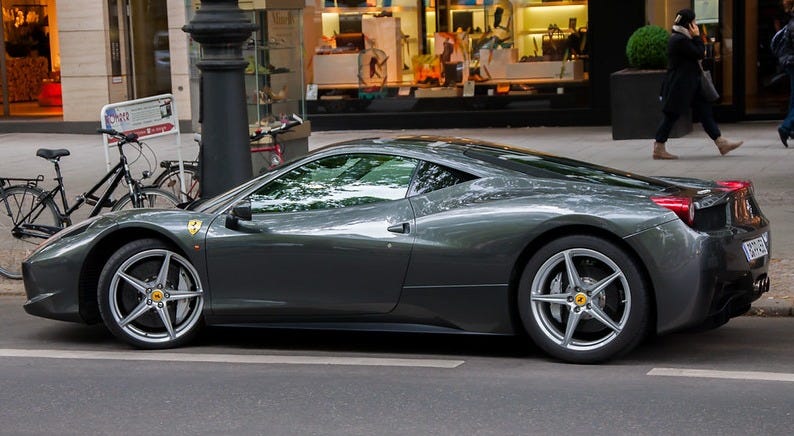
In Berlin, Ku’damm is Autoposer central. On Saturday afternoons, it’s packed with G-Wagons, Porsches, Lambos and Bentleys, complete with carspotters whose passion is snapping pics of the 500 horsepower coupés and SUVs cruising by.
It’s a counterpoint to those parts of Berlin inhabited by vegans and bike riders. While a lot of the cars are owned by rich people, some are rented for the day by 18-year-old kids who got their license two weeks ago.
It was right here on Ku’Damm that, in 2016, two young men raced through several red lights at a speed of 160 km/h. One of the cars hit a Jeep, instantly killing a 63-year-old. Both Marvin N., whose car hit the Jeep, as well as the other racer, Hamdi H. were sentenced to life in prison for murder. In practice, a life sentence means a minimum of 15 years behind bars. Marvin N. later received another 13 years for attempted murder.
The Ku’damm case triggered new legislation in 2017: up to two years in prison just for taking part in races; up to 10 years for racing that results in death or injury.
Harsher penalties don’t seem to have had the desired affect. The news is full of stories of races in cities, on autobahns and country roads.
In April, a court sentenced a young man to 13 years. In a race through the streets of Ludwigsburg, he hit and killed two young women at the entrance to a gas station.
While there are no national statistics on the phenomenon, some states have begun tracking it. In North Rhine-Westphalia, 19 deaths could be attributed to illegal races in 2025. An estimated 2,384 illegal races were reported in the state last year, resulting in 663 accidents. Cities like Cologne have set up special police prevention units to monitor for illegally tuned cars and give educational talks to susceptible young people.
Hamburg has a SOKO Autoposer unit that cruises around town scoping for illegally tuned cars.
Traffic psychologist Wolfgang Fastenmeier, sees little hope when it comes to preventing these men from doing what they do:
“Their personality structure suggests that they are highly impulsive and aggressive individuals. They have little self-control, a weak sense of responsibility and poor social skills. Essentially, they are indifferent to others and are therefore willing to accept that they may cause them harm.”
“They live in their own little bubble and often have no school qualifications, so they have no prospects either. I don’t see how one could achieve anything with standard preventive measures, that is, educational measures aimed at raising awareness of risks and encouraging risk avoidance. Nor do I believe that harsher penalties, which is often the first instinct of politicians, are effective. Convictions may be a source of satisfaction for society, but they are merely a drop in the ocean...”
One option for petrolheads to scratch their itch is to visit the Nürnbergring, where they can push their cars to the limit on “tourist drives” at the legendary race track. But that’s expensive and obviously not going to fully satiate their craving.
Germany is not even the worst country when it comes to illegal street racing though the massive car industry, with its focus on performance and luxury, definitely feeds into the Autoposer culture. The fact that long stretches of the autobahn still have no speed limit surely normalises driving at ridiculous speeds. Speed freaks from around the world come to Germany to legally drive at 400kph.
This behaviour says something about our times: lost young men clamoring for community, acknowledgement and status while risking their own lives and the lives of others for a kick. Unless we commit massive resources to addressing the wider negative impacts of social media, educational failure, and exclusion, there’s no reason this car culture won’t continue to thrive.
Weirdly, the obsession with tuned, loud combustion engines comes at a time when the Chinese electric car industry is beginning to have German brands for lunch. Just yesterday, I noticed at least ten BYD SUVs in town. When all cars are self-driving EVs, will anybody want to race them?
Thanks for reading!
Maurice
What else happened this week?
💥Pentagon likely to cancel missile deal with Germany over fears of Russia
😔 Reconstructing the site of the forgotten first genocide of the 20th century
🕷️ Nosferatu spiders reach the Baltic coast
🎨 Max Ernst: The Surrealist and the Fascist Monster
🎞️ Klaus the forklift driver: This German short (splatter) film from the 1990s is hilarious
💰 Money-Saving Tip of the Week from Smart Living in Germany
Loyalty to a service provider is rarely rewarded: most companies offer their best prices to new customers and keep long-term customers on older, pricier contracts. The result is that staying put often means paying more than someone who just signed up.
That means that it's worth reviewing your ongoing contracts every year or two – phone plans, home internet, electricity, and insurance all have competitive markets with regular new-customer offers. And you don't even always have to switch: sometimes calling your current provider and mentioning that you found a better price elsewhere is enough – they may offer a discount, an upgrade, or better contract conditions to keep you. To stay on top of the best deals in Germany, subscribe to the Smart Living in Germany newsletter.
My other newsletters:
Friends:


I’ve been an automobile enthusiast since I was a child and I despair at the degree of wanton stupidity that endangers our communities. We’ve had street-racing related deaths within a mile of our home. We regularly hear street drags happening on the boulevards adjacent to our neighborhood. Local law enforcement monitors social media for intersection and parking lot “takeover events” that inevitably result in illegal drifting contests and frequent accidents. It’s organized chaos at its worst. Perpetrators who are apprehended face immediate vehicle impoundment, license revocation and criminal prosecution. It’s not enough. The herd mentality persists.
We’re just off Tauentzienstraße, and these maniacs are a real pain in the arse…
But driving like a maniac is ubiquitous all over Germany. I simply don’t get it…
But, sometimes, as Freud said of cigars, sometimes a big car means they really do have very small dicks!
Great piece, Maurice…cheers!